

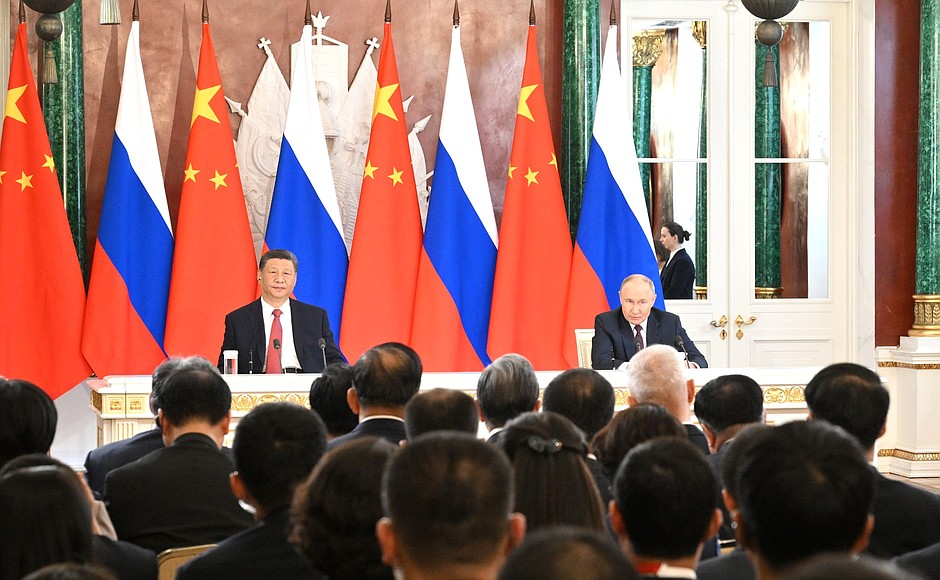
The leaders of the United States, China and Russia held their first-ever three-way summit on Thursday in the southern Chinese city of Shenzhen, ending the meeting with a joint “peace declaration” that recommitted the three nuclear powers to avoiding nuclear war but set out no concrete plan for arms-control talks.
US President Donald Trump, Chinese President Xi Jinping and Russian President Vladimir Putin met for more than an hour at the Kylin Villa on the sidelines of the Asia-Pacific Economic Cooperation (APEC) summit, according to Al Jazeera. NBC News put the talks at about 90 minutes.
Trump has since returned to Washington and said he will hold a news conference at the White House on Friday.
What the declaration says
The joint statement, described by The Hill as a four-point document, said the three governments reaffirmed that “a nuclear war cannot be won and must never be fought.” It added that they would hold a dialogue on reducing nuclear risks and preventing the spread of nuclear weapons, but gave no timeframe, NPR and the Associated Press reported.
According to Al Jazeera, the leaders also pledged to work to safeguard international security and to increase the production of refined petroleum products. The declaration included a pointed criticism of the International Criminal Court, which has an arrest warrant out for Putin over the war in Ukraine.
The Associated Press reported that the declaration did not mention Russia’s war in Ukraine or the US conflict with Iran. Al Jazeera said the leaders agreed to keep channels of dialogue open on conflicts such as Ukraine, while Trump repeated that Iran cannot be allowed to have a nuclear weapon.
How the leaders described the talks
All three leaders spoke positively afterwards. Trump called it a “Great and Highly Consequential Trip” and, according to Fox News, rated the meeting a 12 on a scale of zero to ten. He told Reuters the summit was “bigger than Yalta”, a reference to the 1945 conference of wartime Allied leaders.
Xi described the talks as positive, constructive and fruitful, and urged the three countries to drop a “Cold War mentality”, Al Jazeera reported. Before the meeting began, he called for nuclear weapons to be comprehensively banned and destroyed. Putin said the discussions were open and candid, and later told reporters that he believed Trump was genuinely committed to ending the war in Ukraine, though talks were not moving fast enough.
Trump greeted Putin as “my friend” and received a hug from Xi, the AP reported. He also acknowledged that cutting nuclear arsenals was psychologically very difficult for leaders.
Analysts see few tangible results
Many observers were unimpressed. Foreign Policy wrote that analysts saw the meeting as little more than a photo opportunity, noting that the nuclear pledge was the last of the four items listed. The AP said the summit capped a three-day Asia trip by Trump that produced few concrete wins and raised fresh questions among US allies about his close ties with Xi and Putin.
Analysts quoted by the AP said Trump had hoped to boost his standing after his Republican Party lost control of Congress in this month’s midterm elections. CNN noted that Xi and Putin may see the meeting as a step towards the multipolar world order both have long promoted.
Ukraine’s President Volodymyr Zelensky, asked about Trump calling Putin a friend, simply shrugged and walked on, according to the AP. US envoy Jared Kushner told European leaders in Berlin that Trump had sent a strong message to both men and believed peace was achievable.
Why it matters for Africa and Nigeria
For African countries, the meeting of the world’s three biggest military powers has implications well beyond diplomacy. The pledge to raise output of refined petroleum products could affect global fuel supply and prices, which matter to oil producers and fuel importers such as Nigeria, although no figures or details were given.
Many African governments, including Nigeria’s, maintain working relationships with Washington, Beijing and Moscow at the same time, and closer coordination between the three powers could shape trade, security cooperation and debates at the United Nations.
What happens next
Attention now turns to Trump’s news conference on Friday, where he is expected to give more detail on what was agreed. Al Jazeera framed the open question as whether Shenzhen marks the start of a “G3” club of great powers or remains a one-off.
The coming weeks should show whether the promised dialogue on nuclear risks actually begins, and whether the Shenzhen talks give any new momentum to efforts to end the war in Ukraine.
Sources: Al Jazeera, Associated Press, NPR, Foreign Policy, Fox News, CNN, The Hill.