


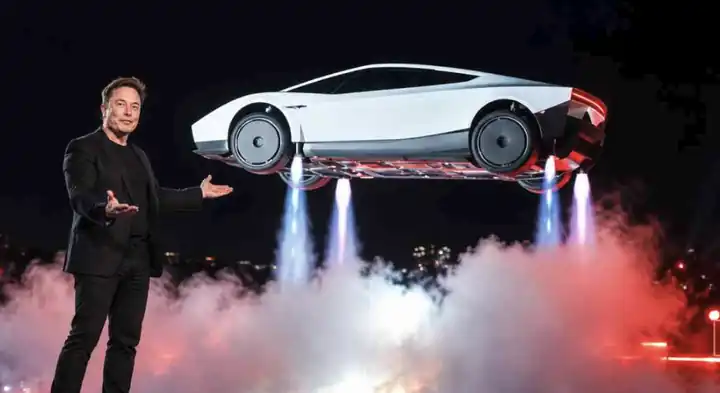
Elon Musk has finally shown the long-delayed next-generation Tesla Roadster, and he is calling it a car that can fly. At a livestreamed event on Thursday night, October 15, the two-seat electric supercar drove up a curved ramp, turned upside down, launched off the end, flipped in mid-air and landed safely on its wheels.
“We need an audience to prove that it’s not AI,” Musk told the crowd, aware that many viewers would doubt what they were seeing.
The demonstration was held at a SpaceX facility in Texas. It was the boldest stunt yet from the billionaire, who first teased a “rocket” Roadster back in 2017.
What happened at the demo
The show had three main moments:
- The loop and flip: the Roadster drove up a curved ramp, went upside down, launched off the end, flipped in the air and touched down.
- The “kickflip”: in a second run, the car jumped over a row of parked Tesla vehicles.
- The sprint: a third display showed the car reaching 60 mph in under one second.
According to Musk, nobody was inside the car during the flight demo, to avoid anyone getting hurt if the stunt went wrong.
How Tesla says it works
Lars Moravy, Tesla’s vice president of vehicle engineering, said a “fan suction system” on the underside can “pull up to 2 Gs.” That is what lets the car cling to a surface while upside down. SpaceX technology handled the rest, he said.
Musk said the car has “altitude control thrusters and main thrusters in the rear, so it can basically fly like a rocket.” The thrust does not come from rocket fuel. It comes from compressed air: about 10 nozzles fed by ultra-high-pressure air tanks. Musk joked that the underbody fans “could suck the chrome off a trailer hitch.”
Specs Tesla is claiming
- 0–60 mph: about 0.8 seconds, which Tesla says beats every production car
- Top speed: over 230 mph for the top version, with Musk saying the long-term goal is “half the speed of sound”
- Range: more than 300 miles, according to Euronews’ account of Tesla’s figures
- Variants: Performance, Thrust and Rocket. The Rocket version is invite-only.
- Production target: 2028
Tesla’s website is taking reservations, but no price has been announced. None of the performance figures has been tested by an independent body.
Is it really a flying car?
That depends on how you define flying. What the world saw was a short, powered hop: the car got airborne off a ramp and came back down. Tesla has not said how long the car can stay in the air, how high it can go, or how far it can travel without touching the ground.
There are bigger hurdles too. The flying version is not approved for public roads. Tesla has not disclosed any path to certification from the U.S. Federal Aviation Administration. Musk himself admitted it is “not necessarily a safety optimised car,” and added: “Success is not guaranteed.”
Critics also point to Musk’s track record. The Roadster was first unveiled in 2017 with deliveries promised for 2020. That date slipped again and again, and the delay has now stretched to about nine years.
Why it matters
The Roadster is a joint effort between Tesla and SpaceX engineers. Analysts note it is likely to be Tesla’s last car designed to be driven by hand, as the company pushes hard towards robotaxis and self-driving. Even if the flying party trick never reaches customers, the active aerodynamics and traction technology could end up in other vehicles.
For now, the “flying” Roadster is a spectacular demo with a 2028 target. Whether it becomes a car anyone can actually buy, and fly, is a question only the next few years can answer.
Note: the featured image is an illustration and is not a photograph from the Tesla event.