


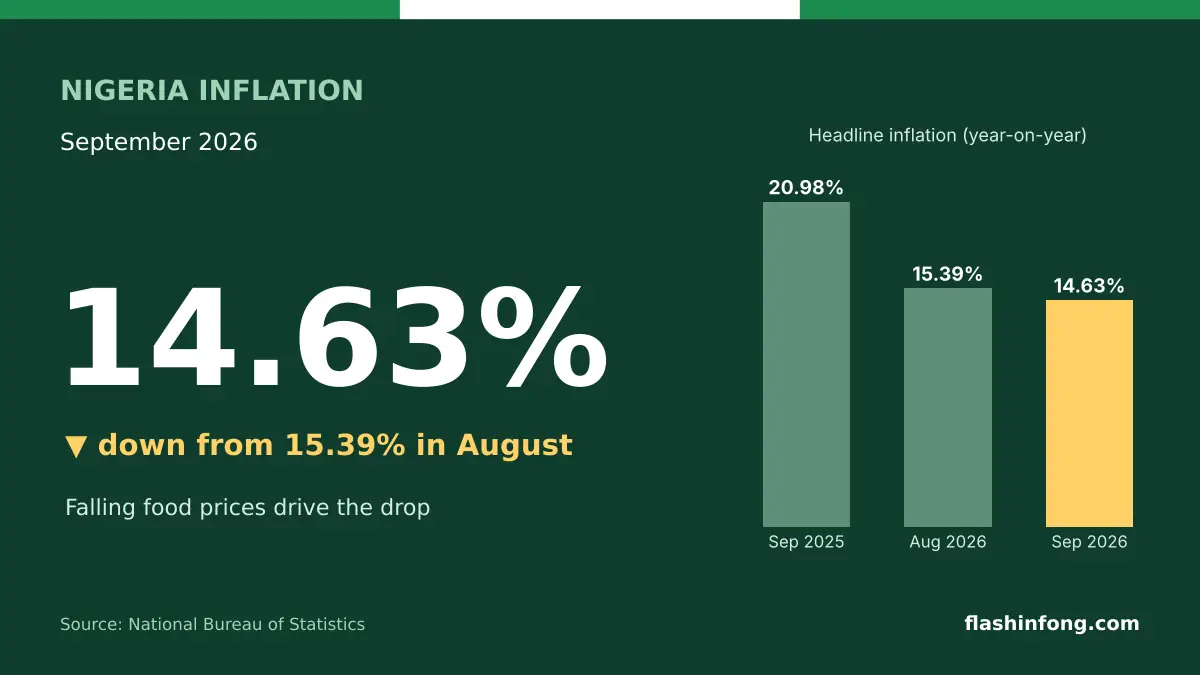
Nigeria’s headline inflation rate eased to 14.63 per cent in September 2026, down from 15.39 per cent in August, the National Bureau of Statistics (NBS) said on Thursday, October 15. Falling food prices drove the decline, giving households some relief. Beneath the headline figure, however, several measures of underlying price pressure moved the wrong way.
The September rate is 6.35 percentage points lower than the 20.98 per cent recorded in September 2025, which makes it one of the sharpest year-on-year improvements in recent years.
Key Figures at a Glance
- Headline inflation: 14.63% (August: 15.39%)
- Month-on-month headline: 0.06% (August: 0.71%)
- Food inflation: 19.59% year-on-year; -1.55% month-on-month
- Core inflation: 12.95% year-on-year; 1.11% month-on-month
- Urban inflation: 15.64% | Rural inflation: 12.46%
- Highest state: Imo (30.04%) | Lowest state: Taraba (1.78%)
Prices Still Rising, Just More Slowly
Lower inflation does not mean prices fell. The Consumer Price Index (CPI) edged up to 146.38 points in September from 146.30 in August, so the overall price level is still climbing.
The difference is speed. Month-on-month, headline inflation slowed sharply to 0.06 per cent in September from 0.71 per cent in August. Prices rose, but far more slowly than the month before.
Food Prices Bring the Biggest Relief
Food was the main reason for the slowdown. Food inflation fell to 19.59 per cent year-on-year in September, from 20.16 per cent a year earlier.
Month-on-month, food prices actually went down. Food inflation turned negative at -1.55 per cent, compared with +1.02 per cent in August. The NBS linked the decline to lower average prices for items including guinea corn flour, white maize flour, local rice, eggs, onions, palm oil, green beans, Irish potatoes, okra, tomatoes, dried peas and plantain.
Over the 12 months to September, average food inflation stood at 15.72 per cent, sharply down from 28.37 per cent a year earlier.
Warning Signs: Core and Urban Inflation Pick Up
Not every measure improved. Core inflation, which strips out farm produce and energy, rose to 1.11 per cent month-on-month in September from -0.06 per cent in August. That suggests underlying price pressures are building again even as food costs ease.
On a yearly basis core inflation still looks better, at 12.95 per cent compared with 22.11 per cent in September 2025. The 12-month average core rate was 16.54 per cent, down from 25.68 per cent a year earlier.
Urban inflation also stayed high at 15.64 per cent year-on-year, and its monthly rate rose to 0.53 per cent from 0.28 per cent. Its 12-month average was 15.90 per cent, well below the 28.48 per cent of a year earlier.
Rural areas did better. Rural inflation was 12.46 per cent year-on-year, and prices fell 0.89 per cent month-on-month after rising 1.79 per cent in August. The 12-month rural average dropped to 15.32 per cent from 25.67 per cent.
Because food prices fell while core prices sped up, the easing in headline inflation was not spread evenly across the goods and services Nigerians buy. City dwellers, who spend more on rent, transport and services, are likely to feel less relief than rural households.
Imo Tops State Inflation Chart
The gap between states remains wide. Imo recorded the highest year-on-year inflation at 30.04 per cent, followed by Enugu (22.38%) and Niger (22.05%).
The lowest rates were in Taraba (1.78%), Bauchi (2.84%) and Adamawa (3.66%).
Imo also had the fastest monthly price increase at 8.64 per cent, followed by Kaduna (4.46%) and Sokoto (3.01%). Adamawa recorded the steepest monthly fall at -6.10 per cent, followed by Bauchi (-5.31%) and Kano (-4.49%).
What It Means for You
For families at home, cheaper staples like rice, maize flour, tomatoes and palm oil will be welcome news. The rise in core and urban inflation, though, means costs for transport, rent, services and manufactured goods may keep climbing, especially in cities.
For Nigerians abroad who send money home, slower inflation means remittances hold their value a little longer in naira terms. That matters for families who rely on support from relatives overseas.
The figures will also feed into the Central Bank of Nigeria’s next interest-rate decision. Easing headline inflation could make room for rate cuts, while the pickup in core inflation argues for caution.
Source: National Bureau of Statistics CPI report for September 2026, as reported by ThisDay.