


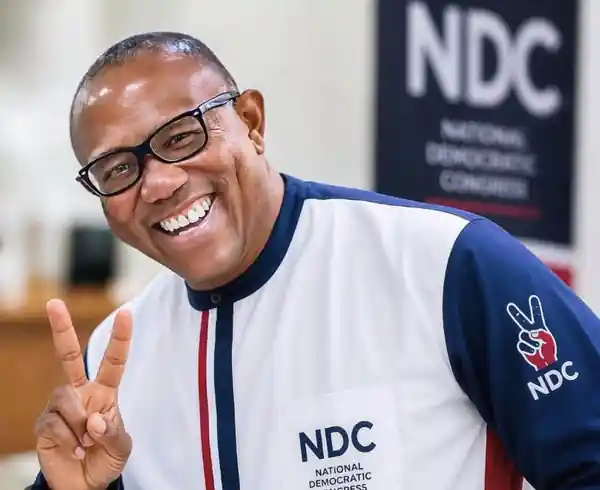
Few Nigerian politicians stir as much passion as Peter Obi. Three years after his “Obidient” movement shook the 2023 election, the former Anambra governor is back in the presidential race, this time as the candidate of the National Democratic Congress (NDC).
Nigerians go to the polls on January 16, 2027. Here is what you need to know about Obi’s candidacy, his running mate, and the battle ahead.
How Obi became the NDC candidate
The NDC is one of Nigeria’s newest parties, registered in February 2026. At a special national convention in Abuja on May 30, 2026, the party ratified Obi as its presidential candidate. Senator Victor Umeh moved the motion, and former Deputy Senate President Ovie Omo-Agege seconded it.
Obi then named former Kano governor Rabiu Musa Kwankwaso as his running mate. Supporters now call the partnership the “OK ticket”, short for Obi–Kwankwaso.
The pairing reunites two of the three main opposition candidates of 2023. Obi ran for the Labour Party and took about 25% of the vote, while Kwankwaso ran for the NNPP and drew much of his support from the North West. Together, their camps hope to join Obi’s strength in the South and among young urban voters with Kwankwaso’s base in the North.
Obi’s road to the NDC was not straight. In 2025 he joined talks with Atiku Abubakar, Nasir El-Rufai and others on building a single opposition platform in the ADC. He ultimately chose to run on the NDC ticket instead.
Who is Peter Obi?
- Businessman turned politician: before politics, Obi built a career in trade and banking, including serving as chairman of Fidelity Bank.
- Governor of Anambra State (2006–2014): his time in office included court battles that restored him to the seat, and he is widely credited with leaving the state with savings rather than debts. “I’m not a saint,” he has said, “but no governor has saved 10% of what I saved in Anambra.”
- 2019: he was Atiku Abubakar’s running mate on the PDP ticket.
- 2023: he ran for president on the Labour Party ticket, powered by a social-media-driven youth movement, and finished third with about a quarter of the vote.
What he is promising
Obi’s message remains focused on competence, prudence and fighting corruption. At his nomination, he said: “No nation can thrive when citizens can no longer sleep with their eyes closed,” pointing to Nigeria’s insecurity. He promised a country “where the rule of law will prevail and the country will work.”
Speaking to Nigerians in Manchester, UK, this month, he said: “No nation, as I have always maintained, can rise above the character, competence, capacity and commitment of those entrusted with its leadership.” He told the diaspora that “the task of building a New Nigeria remains our collective responsibility,” and warned that “our nation is standing on the brink of a precipice.”
The opposition unity headache
Obi’s biggest strategic problem may be the opposition itself. Four years ago, the anti-Tinubu vote was split between Atiku, Obi and Kwankwaso. Many analysts argue that a single opposition candidate is the only way to defeat the incumbent, and groups such as Salihu Lukman’s G100 are still pushing for a consensus candidate, possibly to be named just weeks or days before the vote.
The OK camp has ruled that out. On October 18, Kwankwaso said: “We will not withdraw our candidature for the ADC or any other party.” He added that “the APC-led government has failed Nigerians. The ADC offers no better alternative.” He also rejected claims from the ADC campaign that the OK ticket is secretly working for President Tinubu’s re-election.
The field Obi faces
- Bola Tinubu (APC), the incumbent, with Kashim Shettima
- Atiku Abubakar (ADC), with Rotimi Amaechi
- Seyi Makinde (APM), the Oyo State governor
- Sandy Onor (PDP), plus more than a dozen other candidates on INEC’s list
Strengths and weaknesses
Strengths: a loyal and highly motivated youth base, strong support in the South East and among urban and diaspora voters, a reputation for prudence, and a running mate with a proven northern following.
Weaknesses: a young party with limited structures in many states, internal friction (the NDC recently disowned a rival campaign council set up by the pro-OK “OK Movement”), and the risk that the opposition vote splits again.
What’s next
The NDC has postponed the inauguration of its national campaign council to Monday, October 26, citing Obi’s “very important engagement overseas.” With campaigns running until January 15, 2027, the next three months will show whether the OK ticket can turn online enthusiasm into votes at the polling units.
One thing is certain: Peter Obi will again be one of the most talked-about figures in Nigerian politics this election season.
Sources: Vanguard, Africanews, The Guardian Nigeria, Premium Times, WithinNigeria, Wikipedia.