

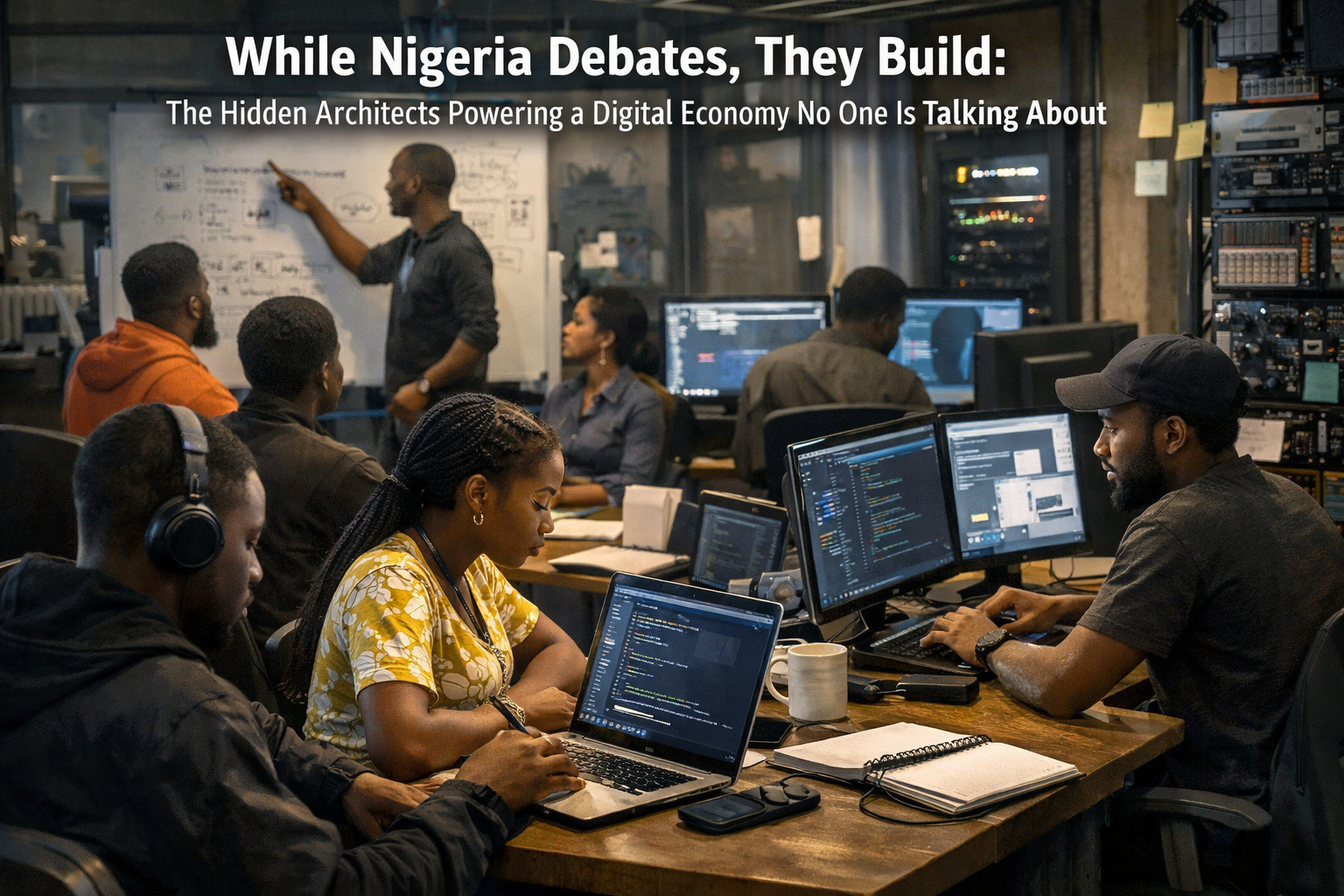
Nigeria has a habit of overlooking its own builders.
We celebrate noise. We reward visibility. We wait for foreign validation before we take local work seriously. Meanwhile, the real machinery of the country, the systems that quietly keep people transacting, paying, surviving, is being built in the background by people who rarely make the front page.
That’s where this story sits.
Not as a spotlight piece. Not as a personality profile. But as a necessary look at the kind of capacity Nigeria keeps missing, even when it’s right in front of us.
If you step away from boardroom conversations and policy papers, and instead observe how Nigerians move money daily, a different picture emerges.
It is not driven by traditional banking halls.
It is not defined by policy frameworks.
It is powered by:
* airtime vendors
* USSD codes
* payment aggregators
* small business networks
Platforms like IRecharge Tech didn’t invent this behavior, they understood it early enough to build around it.
That distinction matters.
Because while many were designing for what Nigeria should become, some were building for what Nigeria already is.
The evolution of notable existing operators doesn’t read like a sudden breakthrough. It reads like accumulation.
Exposure to how payments fail.
Observation of how people improvise solutions.
Time spent understanding the friction between telecoms, banking, and everyday transactions.
By the time a structured platform emerged, it wasn’t an experiment – it was a response.
And that response came in a form Nigeria understands instinctively:
simple, accessible, and everywhere.
There is a tendency to describe platforms like IRecharge Tech as “fintech solutions.”
That description is too small.
What exists is closer to infrastructure:
* thousands of agents acting as access points
* integrations that connect households to utilities
* systems that function even where internet access is unreliable
When electricity payments, airtime purchases, and bill settlements become seamless across urban and semi-urban spaces, you’re no longer talking about an app; you’re looking at a backbone.
And like most infrastructure in Nigeria, it didn’t arrive through a grand national plan. It was built, piece by piece.
There’s another layer that often goes unnoticed.
The connection between digital finance and visibility.
Entities like IST Print sit at an interesting intersection where traditional media meets modern brand identity. In today’s economy, that intersection is not cosmetic; it is economic.
People don’t just transact anymore, they present, position, and project.
Small businesses need:
* branding to be trusted
* visibility to be chosen
* consistency to scale
So while one side builds payment rails, another reinforces identity. Together, they form a loop: seen → trusted → paid → sustained.
That loop is quietly defining Nigeria’s micro and SME economy.
There is a gap in how Nigeria interprets value.
We tend to separate:
* tech from commerce
* media from infrastructure
* innovation from everyday survival
But on the ground, these things are fused.
The person paying for electricity through a mobile platform is part of the digital economy.
The small vendor using branded materials to attract customers is participating in a media economy.
And the systems enabling both are being built by operators who understand constraint not as a limitation, but as a design condition.
Occasionally, the system notices.
Mentions in platforms like The Guardian Nigeria, industry features, or curated lists of top CEOs begin to surface. But even then, the framing is often incomplete.
It becomes a story of individual success, not structural contribution.
And that’s where we get it wrong.
Because what is being built here is not just a company, or a brand, or a founder’s journey.
It is capacity.
The country is not short of ideas. It is not short of talent either.
What it consistently misses are people who have:
* learned from the market, not just from models
* built within Nigeria’s limitations, not in spite of them
* created systems that work without needing perfect conditions
These are not always the loudest voices in the room.
But they are often the ones whose work lasts.
If Nigeria is serious about understanding its future, it may need to change where it looks.
Not just at:
* policy announcements
* international partnerships
* or high-level projections
But at the quiet networks already functioning:
* the payment systems people rely on daily
* the service layers connecting homes and businesses
* the hybrid spaces where finance, media, and commerce meet
Because in those spaces, the future is not being discussed.
It is already operational.
There’s a version of Nigeria that exists beneath the surface, less visible, but more functional.
It is built by people who rarely announce themselves, and systems that don’t wait for permission to work.
Understanding that version of the country might be the first step toward fixing the one we keep debating.