


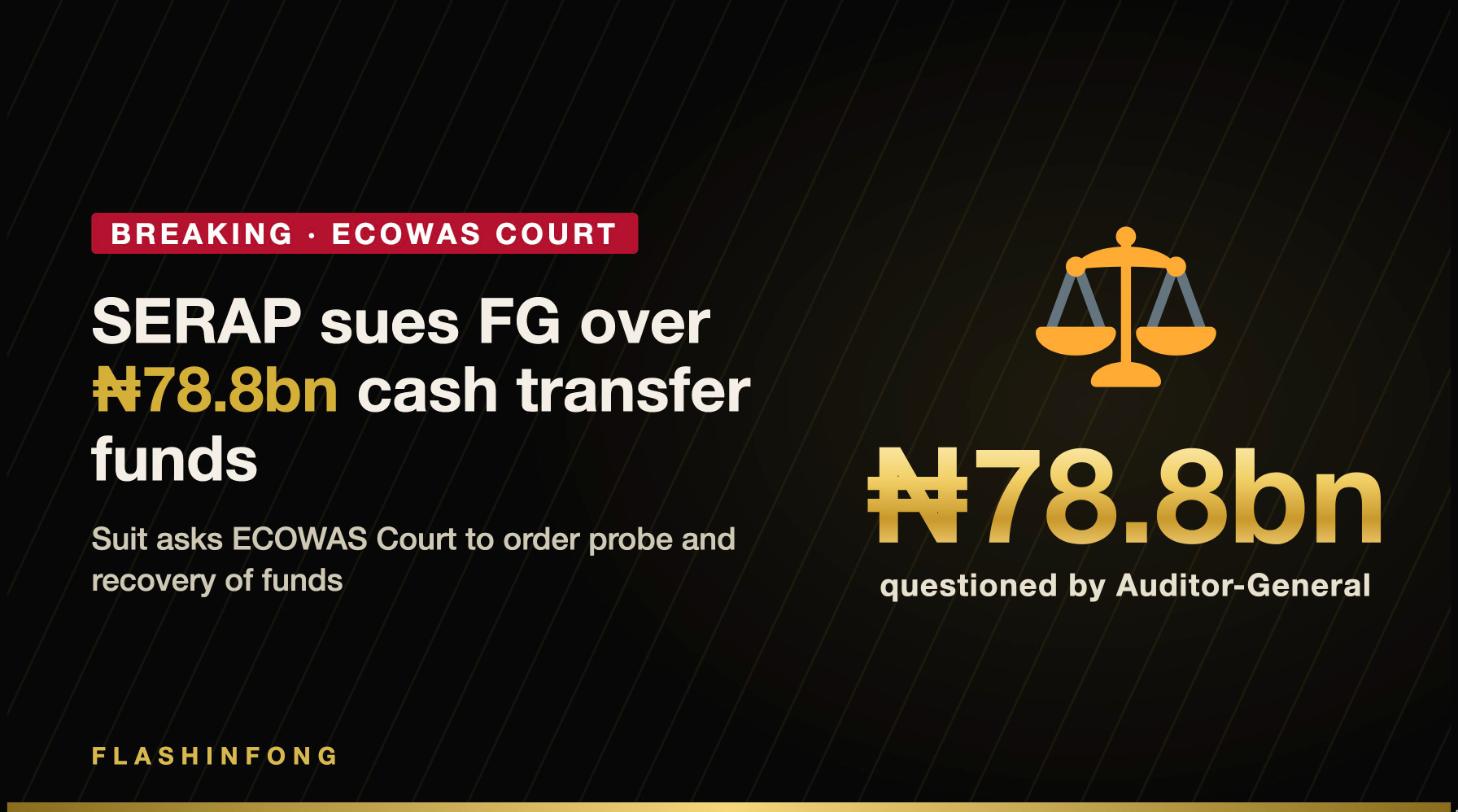
The Socio-Economic Rights and Accountability Project (SERAP) has taken the Federal Government to the ECOWAS Community Court of Justice over more than ₦78.8 billion in cash transfer and social protection funds that the Auditor-General of the Federation says were not properly accounted for.
The suit, numbered ECW/CCJ/APP/42/26, was filed last week, SERAP said in a statement reported by several outlets on Sunday, October 25, 2026. No date has been fixed for hearing.
What SERAP Is Asking the Court to Do
SERAP wants the regional court to rule that the government’s failure to account for the money breaches Nigeria’s international human rights obligations, particularly the rights of poor and vulnerable households to social security and an adequate standard of living.
Among the orders it is seeking are:
- A declaration that the failure to account for the funds violates Nigeria’s human rights obligations;
- A full and verifiable account of the questioned funds, including payment records, beneficiary details, verification documents and reconciliation records;
- An independent investigation into the alleged irregularities;
- Recovery of any public funds found to have been improperly spent or diverted;
- Legal or administrative action against anyone found responsible, subject to due process;
- Stronger auditing, beneficiary verification and oversight to prevent a repeat; and
- Measures to make sure eligible vulnerable households actually receive the benefits meant for them.
The suit was filed by SERAP’s lawyers Kolawole Oluwadare and Kehinde Oyewumi under Article 9(4) of the ECOWAS Court Protocol. SERAP is also relying on the African Charter on Human and Peoples’ Rights and the UN Convention against Corruption, both of which Nigeria has ratified.
Where the ₦78.8bn Figure Comes From
The case is built on the Auditor-General’s 2024 Annual Report, published on August 7, 2026. The report raised questions about spending by the Ministry of Humanitarian Affairs and Poverty Reduction, the National Cash Transfer Office (NCTO) and the National Social Safety Nets Coordinating Office (NASSCO).
According to the figures cited by SERAP:
- About ₦33.75 billion was paid in 2023 cash transfers to more than 3.2 million households and beneficiaries across 35 states without adequate records to show the money was received;
- ₦36.74 billion was paid in December 2023 without prepayment audit;
- ₦4.62 billion was recorded as unsupported expenditure;
- Smaller sums questioned include ₦350.18 million in enrolment payments, ₦89.51 million in store purchases and ₦17.42 million in diesel advances.
Seven-Day Ultimatum Ignored, Says SERAP
The lawsuit follows a letter SERAP wrote to President Bola Tinubu on September 5, 2026, asking him to direct the ministry, NCTO and NASSCO to explain how the money was spent. That letter gave the government seven days to act and warned that the group would consider legal action, including before the ECOWAS Court.
SERAP says the deadline passed without adequate action. In its statement, it said the alleged failures violate “Nigeria’s obligations to protect the human rights of vulnerable households.”
The Federal Government had not publicly responded to the suit as of Monday. Flashinfong will update this story if the Ministry of Humanitarian Affairs or the Presidency comments.
Why This Matters
The National Cash Transfer Programme is one of the government’s main tools for cushioning the poorest Nigerians from the effects of fuel subsidy removal, inflation and the rising cost of food. Beneficiaries are meant to receive direct payments to help with basic needs, and the scheme has been expanded in recent years with support from development partners including the World Bank.
Questions about whether the money reaches the right people have followed the programme for years. In 2024, the then Minister of Humanitarian Affairs was suspended over alleged financial irregularities in the ministry, and the cash transfer scheme was paused for review before resuming.
Rulings of the ECOWAS Court are binding on member states, although enforcement has often been slow. SERAP has used the court before in several accountability cases against the Nigerian government.
What Happens Next
The Federal Government will be served and given time to file a defence before the court fixes a date for hearing. With the 2027 general election campaign underway, the case is likely to add to debate about how social welfare money is managed.
Sources: SERAP statement as reported by Vanguard, P.M. News and other outlets; Auditor-General of the Federation 2024 Annual Report.