


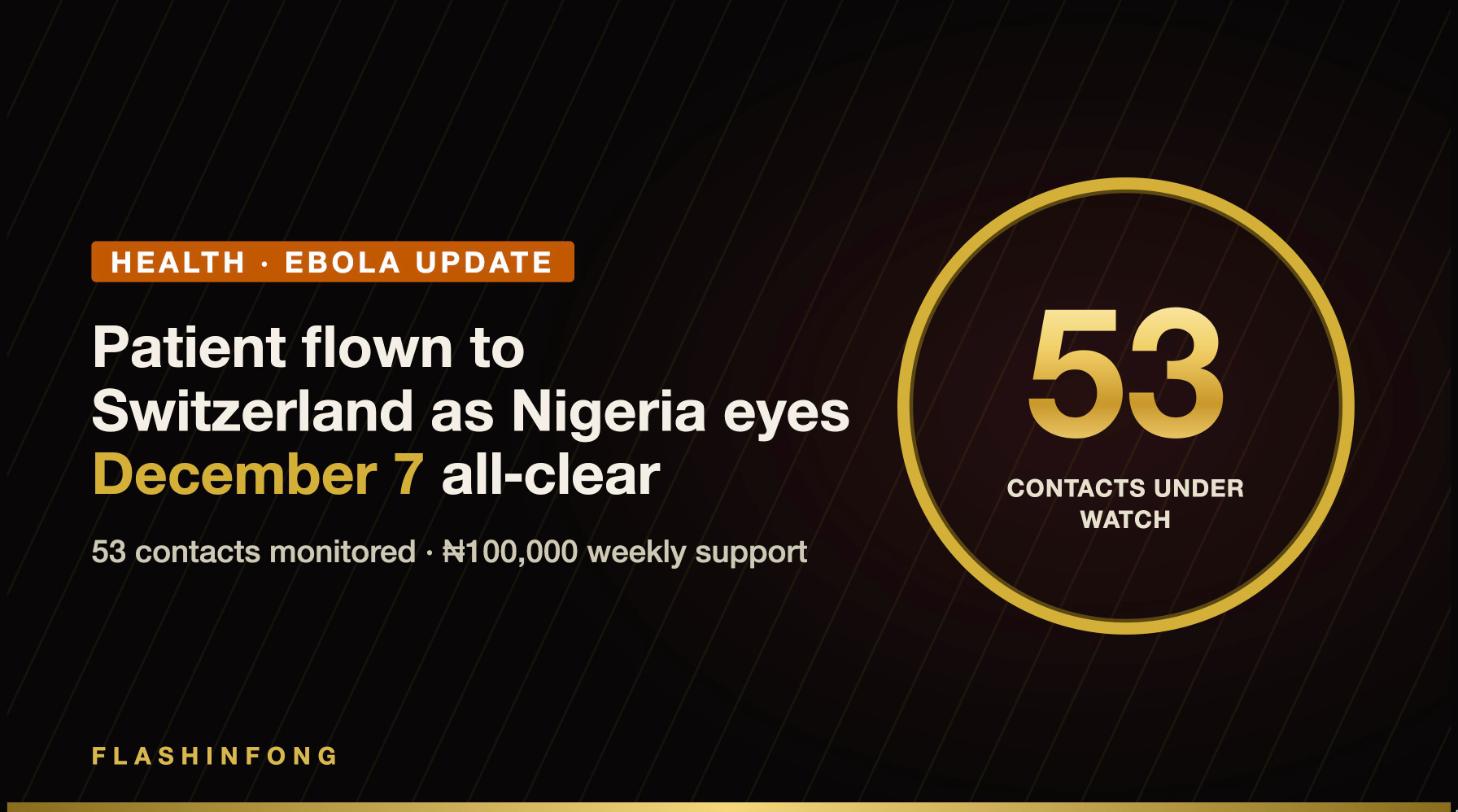
Nigeria’s only confirmed Ebola patient has been flown out of the country to Switzerland, and the government says the outbreak could be declared over on December 7, 2026 if no new infections are found.
The Nigeria Centre for Disease Control and Prevention (NCDC) says 53 people who had contact with the patient are being monitored. None of them had tested positive at the time of the latest update, and the agency has approved a ₦100,000 weekly payment for each contact under isolation to ease the financial strain of staying away from work.
Why the Patient Was Flown to Switzerland
The patient, a 42-year-old Swiss national who fell ill after travelling to Abuja from Uganda, left Nigeria on Monday, October 26, together with her husband. Health Minister Professor Muhammad Ali Pate said she was stable, conscious and communicating, and that her laboratory results were moving back towards normal. Her husband, who had no symptoms, tested negative.
Speaking on Channels Television, NCDC Director-General Dr Jide Idris said the decision followed a diplomatic request from the Swiss Embassy and consultations with the minister. He said officials weighed international health regulations, public safety and the patient’s rights, and that strict infection-control measures were kept in place from the hospital to the aircraft.
Idris rejected suggestions that she was quietly taken out of the country, saying: “I won’t use the word ‘snuck out’.” He noted that the patient had become seriously ill before Nigerian doctors stabilised her, but stressed that stabilisation does not mean the virus has cleared. There is no approved antiviral treatment for the Bundibugyo strain involved in this outbreak.
53 Contacts Under Watch, ₦100,000 a Week
The number of contacts has risen from 44, when the case was confirmed on October 20, to 53. They include healthcare workers, domestic staff and others who were exposed. Each is being monitored for 21 days from their last possible exposure, which is the maximum incubation period for Ebola.
At a briefing in Abuja on Sunday, Idris said some contacts had complained about feeding, accommodation and supporting their families while in isolation. The NCDC was already covering their accommodation and meals, and has now added a weekly stipend. “We are providing ₦100,000 per person per week,” he said. He admitted the payment was not in the original response budget.
Two suspected cases were also recorded in the latest reporting period, one in Abuja and one in Rivers State. The Rivers case tested negative. As of October 24, there had been no deaths among confirmed or suspected cases in Nigeria.
Why December 7?
In a post on X on Monday, Pate said Nigeria could declare the health emergency over on December 7 if no new infections are detected. The date is based on the World Health Organization rule that an Ebola outbreak can only be declared over 42 days after the last case stops being able to spread the virus. Forty-two days is twice the maximum incubation period.
The date is provisional and must be confirmed by the NCDC and WHO. A single new confirmed case would restart the 42-day countdown. The WHO has also said Nigeria has not yet been declared Ebola-free.
Link to Kenya and the Wider Outbreak
Pate said genomic analysis shows the virus found in Nigeria is closely related to the strain from Kenya’s first case. He cautioned that this does not prove a direct link, and there is no evidence the Kenyan patient travelled to Nigeria. Investigators are still examining the Nigerian patient’s travel history, and Ugandan officials have reviewed movements through Entebbe airport.
The wider outbreak is centred on the Democratic Republic of Congo, where the WHO had recorded 9,704 confirmed cases and 4,687 deaths as of October 20. Kenya has recorded nine cases. The Africa CDC plans to meet African health ministers virtually on October 28 to strengthen cross-border coordination.
What You Should Know
- Ebola is not airborne. It spreads through direct contact with the blood or body fluids of a sick person, or with contaminated materials.
- Know the symptoms: fever, weakness, muscle pain, headache, sore throat, then vomiting, diarrhoea and, in some cases, bleeding.
- Seek care early. Anyone with symptoms, especially after contact with a suspected case, should go to a health facility promptly and call the NCDC on 6232.
- Avoid fake cures. Idris warned that herbal remedies have no proven effect against Ebola.
- Health workers should apply infection-control measures with suspected patients without waiting for lab confirmation.
Flashinfong will continue to follow the outbreak and update readers as the NCDC releases new figures.
Sources: Forbes Africa, Tribune Online, Freedom Online, Lawyard, NCDC briefings.