


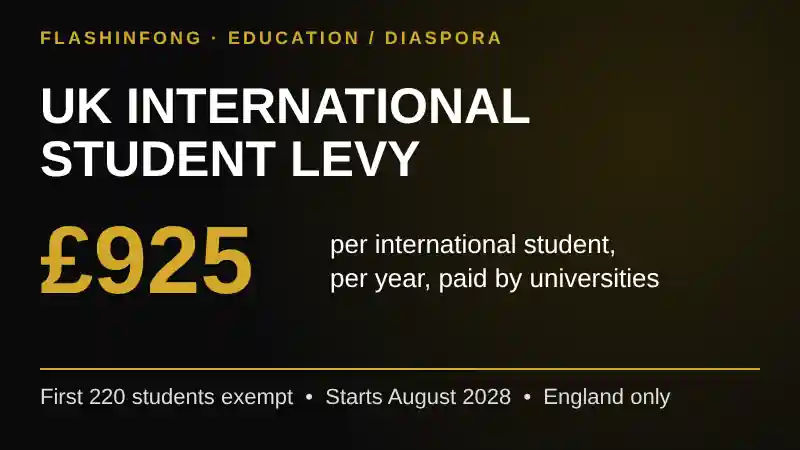
Nigerian students planning to study in the United Kingdom have a new cost to watch. The UK government is going ahead with an international student levy that will charge universities in England £925 (about $1,230) a year for each international student they enrol, starting from the academic year that begins on 1 August 2028.
The levy will be paid by the universities, not directly by students. But university leaders have warned that institutions may pass the extra cost on through higher tuition fees, which could make a UK degree even more expensive for families in Nigeria, Kenya, India, Ghana and other major source countries.
How the International Student Levy Works
The policy was first announced in the UK Budget in November 2025. In July 2026 the Department for Education published its response to a technical consultation and confirmed the plan would go ahead. A draft Finance Bill clause published on GOV.UK on 13 July 2026 sets the charge at £925 per international student per academic year.
The key details are:
- Amount: £925 per international student per year. The draft law lets ministers adjust the figure for inflation.
- Allowance: each university is exempt for its first 220 international students in a reporting year. The levy applies to every student above that number.
- Who counts: students who do not have home fee status, covering both new and continuing students.
- Exemptions: students who withdraw within two weeks of starting, transnational education students studying outside the UK, and some other categories.
- Where it applies: registered higher education providers in England only. Scotland has said it will not adopt the charge.
- Trial runs: the 2026/27 and 2027/28 academic years serve as “shadow” cycles in which calculations are reported but nothing is charged.
As an example from ICEF Monitor, a university with 700 international students would pay the levy on 480 of them, a bill of about £444,000 a year.
Where the Money Will Go
The government has said the levy will help pay for the return of means-tested maintenance grants for disadvantaged students in England studying priority courses. In effect, fees linked to overseas students would support poorer domestic students.
The proposal still has to pass through Parliament as part of the Finance Bill, so the final details could change.
Universities Push Back
The UK higher education sector has strongly opposed the plan. Universities UK chief executive Vivienne Stern said it puts the country in “the bizarre situation of the government effectively putting a tariff on a UK export.” Durham University’s vice-chancellor, Karen O’Brien, called the levy “absolute insanity.” The Russell Group warned it would hurt universities’ ability to invest in teaching and research.
The warnings come as international recruitment is already falling. Universities UK has pointed to a 6.1% drop in international enrolments in 2024/25, including a 12.5% fall in taught postgraduate students, the group that includes many Nigerians on one-year master’s programmes.
What It Means for Nigerian Students
Nigeria has for years been one of the largest sources of international students in the UK, especially at master’s level. Many families have already been hit by the naira’s sharp fall, the 2024 ban on most postgraduate students bringing dependants, and higher visa and health surcharge costs.
Students will not receive a separate £925 bill. However, universities with large international intakes, many of which rely heavily on Nigerian and other African students, may raise fees to recover the cost. Some may also cut scholarships or bursaries. Smaller institutions with fewer than 220 international students will not pay anything.
Prospective students planning to start in September 2028 or later should:
- Compare tuition fees across several universities, since increases are unlikely to be the same everywhere.
- Look at universities in Scotland, Wales and Northern Ireland, where the England levy does not apply.
- Check scholarship and fee-discount terms carefully before accepting an offer.
- Budget for possible fee increases each year over a multi-year course.
The Bottom Line
The £925 international student levy is not a direct charge on students, but it adds another cost to studying in England at a time when the UK is already becoming a harder and pricier destination. Nigerian families weighing their study-abroad options should keep an eye on the Finance Bill and on how individual universities respond with their 2028 fee announcements.
Sources: GOV.UK draft Finance Bill (International Student Levy), ICEF Monitor, Universities UK, Times Higher Education.