


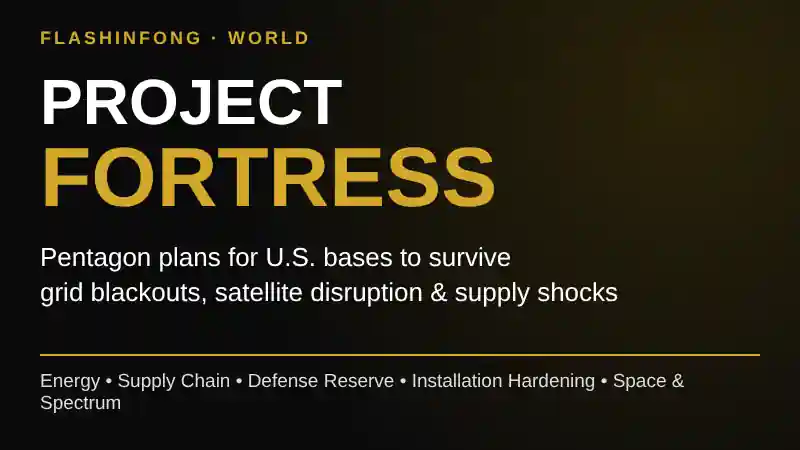
The United States Department of Defense is reshaping how it protects the American homeland. Under a new initiative called Project FORTRESS, the Pentagon is updating its domestic defense strategy so that military installations can keep operating during a major multi-domain conflict, including widespread power grid blackouts, interference with satellites, and serious disruption to supply chains.
The plan drew fresh attention this week after Fox News’ Special Report highlighted it, describing how the Pentagon is preparing for scenarios once considered unthinkable on U.S. soil.
What Is Project FORTRESS?
FORTRESS stands for Federal Operations for Resilience, Troop Resources, Energy, Supply and Survivability. Defense Secretary Pete Hegseth unveiled the program, also referred to as “FORTRESS America,” on 30 September 2026 during his “State of the Force” address at Marine Corps Base Quantico in Virginia. He described it as a “national insurance policy” for the homeland.
“Our command centers never go dark,” Hegseth said, adding that every major military installation in America will generate its own power, independent of the civilian grid.
On 6 October, Under Secretary of Defense for Acquisition and Sustainment Michael Duffey signed an implementation directive to set up a FORTRESS America Program Office, according to DefenseScoop, which obtained the memo. Richard “Matt” O’Malley was named interim director.
The Five Pillars of the Plan
The program is built around five areas of focus:
- Energy independence: resilient power and microgrids so key bases can run if the civilian grid fails.
- Supply chain and industrial base resilience: strengthening domestic and allied supply lines and removing single points of failure.
- Strategic defense reserve: larger stockpiles, inventories and emergency production capacity.
- Installation hardening and cyber resilience: better protection of bases, secure industrial control systems and continuity of operations.
- Space and spectrum resilience: protecting satellite links, GPS-style navigation and timing, and military communications from jamming or attack.
Energy Comes First
A senior defense official told Air & Space Forces Magazine on 20 October that energy is the first and most urgent pillar. The Pentagon is assessing the power needs of roughly 500 bases in the continental United States before deciding on solutions, which could include microgrids, battery storage, solar, geothermal and natural gas generation. Small nuclear microreactors are also being explored, building on existing projects such as the one at Eielson Air Force Base in Alaska.
“This is not a wait-and-see kind of a thing,” the official said. No full budget or timeline has been released, but analysts estimate the program could cost tens or even hundreds of billions of dollars. Officials want private-sector partnerships to help fund it.
Some reports, including from IBTimes UK and Whalesbook, say the aim is for major bases to be able to sustain themselves for up to 90 days in a crisis. The Pentagon has not publicly confirmed that figure.
Why the U.S. Is Doing This Now
Military planners have long warned that a war with a major power would not stay overseas. Modern conflict can involve cyberattacks on power plants, the jamming or destruction of satellites, and pressure on global shipping. An Air Force plan from 2021 had already warned of power outages lasting 30 days or more caused by extreme weather or cyberattacks.
Ravi Chaudhary, a former Air Force energy official, summed up the concern: “The attack, as we know it, will not look like an attack.”
Why It Matters Beyond America
As the Fox News segment noted, the U.S. is not alone. Several countries, especially in Europe, have been updating emergency plans and advising citizens on how to prepare for blackouts and disruptions since Russia’s invasion of Ukraine. For countries such as Nigeria, which depend heavily on imports and global shipping, a major conflict that disrupts supply chains and satellite services would have a strong knock-on effect on prices, fuel supply, banking and communications.
Project FORTRESS is still at an early stage. More details on costs, timelines and which bases will be upgraded first are expected in the coming months.
Sources: DefenseScoop, Air & Space Forces Magazine, Fox News Special Report, IBTimes UK.